Best VPN 2026: Our Top Picks and How to Choose
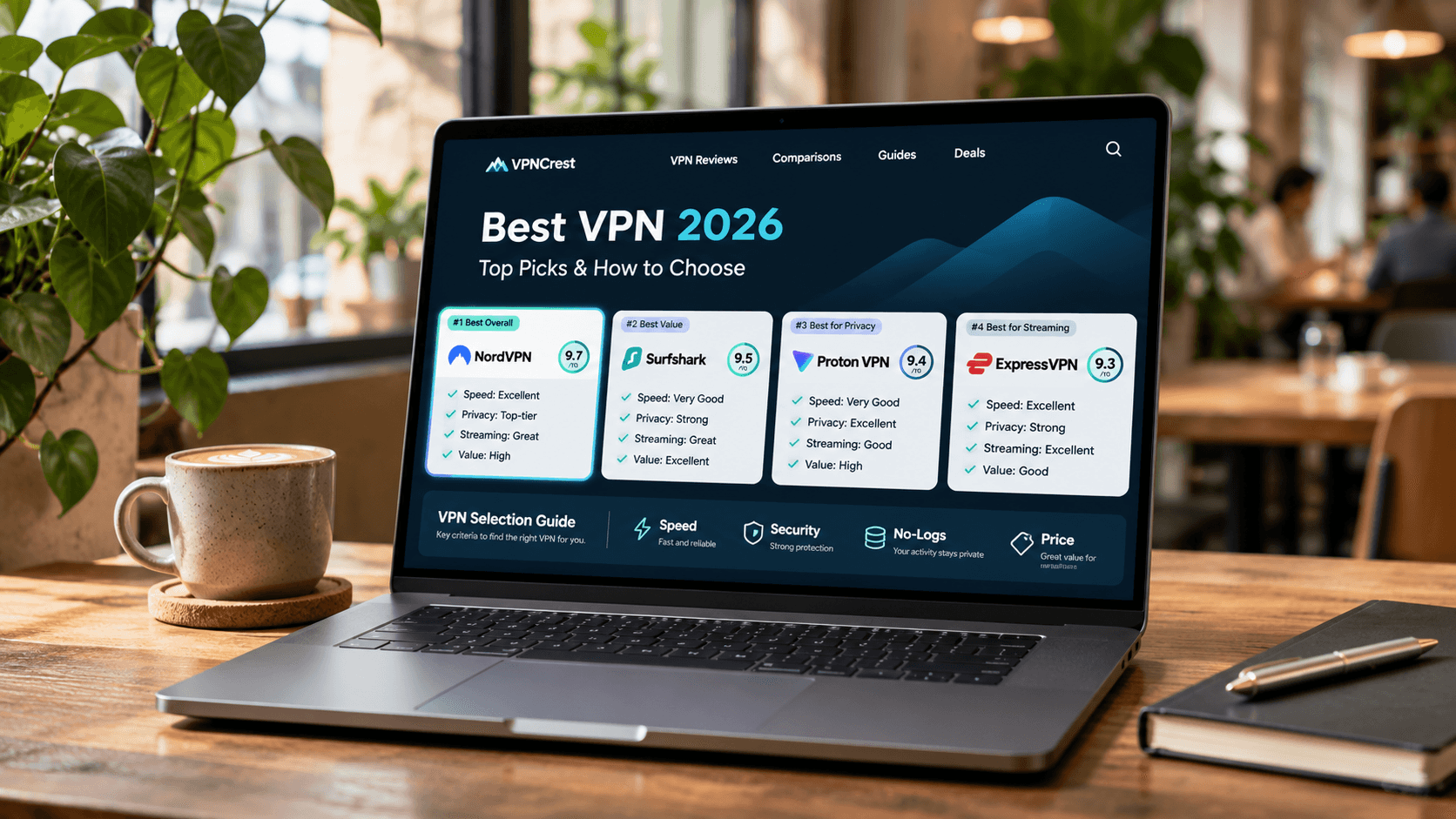
Choosing a VPN in 2026 comes down to a few questions: can the provider prove it does not keep logs, is it fast enough for what you do, and will the price still make sense after the first term? This guide covers the providers we rate highest and the criteria behind our full rating.
Our top picks for 2026
- NordVPN is the best all-rounder. Its no-logs policy has been checked by outside auditors several times, NordLynx is one of the fastest protocols available, and it handles streaming and torrenting well.
- ExpressVPN is the easiest premium VPN to use, with RAM-only TrustedServer infrastructure and its own audited Lightway protocol. It costs more than most rivals.
- Surfshark is the best value for households: unlimited simultaneous connections, a Deloitte-audited no-logs policy and a low long-term price.
- Proton VPN has the best free plan we know of and a paid tier with Secure Core routing, port forwarding and open-source, audited apps.
- Mullvad is our choice when privacy matters most: no email address, cash payments and a no-logs policy that held up during a 2023 police search.
1. Verified privacy, not marketing
Almost every VPN says it keeps no logs. What separates a credible claim from a slogan is evidence: an independent audit by a named firm, RAM-only servers that cannot retain data on disk, and ideally a real-world test such as a court case or server seizure where the provider had nothing to hand over. Our guide on what a no-logs VPN really means explains how to read these signals.
Jurisdiction matters too, but less than many people think. A provider in a privacy-friendly country that has never been audited is a weaker bet than one under tougher laws that has repeatedly proven it stores nothing.
2. Speed that fits your use
Every VPN adds some overhead because your traffic is encrypted and sent through another server. How much you notice depends mostly on three things:
- Protocol: WireGuard and protocols built on it, such as NordLynx, are usually noticeably faster than OpenVPN. See our WireGuard vs OpenVPN comparison.
- Distance: a server in a nearby city will almost always beat one on another continent.
- Server load: large networks make it easier to find a quiet server at busy times.
For browsing and HD streaming, any of our top picks is fast enough. For gaming, latency matters more than raw download speed, so pick the nearest server rather than the most exotic location.
3. Features that solve real problems
Ignore long feature lists and check for the essentials:
- A kill switch that blocks traffic if the VPN drops.
- Split tunneling if banking or local apps refuse to work through a VPN.
- Obfuscation if you travel to countries or use networks that block VPN traffic.
- Port forwarding if you torrent or host anything, a feature only some providers still offer.
4. Price after the first term
Introductory deals can be very cheap, but many providers renew at a much higher rate. Compare the price you will pay over two or three years, not just the first invoice, and check the device limit. Surfshark and Private Internet Access allow unlimited devices, while others cap you at five to ten. Every provider we recommend offers a money-back guarantee, so you can test it on your own connection.
5. Match the VPN to the job
- Streaming: see our best VPN for streaming list.
- Torrenting: look for P2P support and port forwarding in our torrenting picks.
- Privacy first: Mullvad, IVPN and Proton VPN lead our privacy list.
- No budget: start with our best free VPN picks.
Mistakes to avoid
- Picking a VPN only because it is advertised everywhere.
- Trusting a free app from an unknown developer with all your traffic.
- Buying a three-year plan before testing speeds during the refund window.
- Assuming a VPN makes you anonymous. It hides your traffic from your network and ISP, but accounts you log in to still know who you are.
Bottom line
For most people, NordVPN, ExpressVPN or Surfshark will cover everything they need. If privacy is the priority, choose Mullvad or Proton VPN. Whatever you pick, favor providers that can prove their no-logs claims and test them on your own connection before committing to a long plan.