No-Logs VPN: What the Claim Actually Means
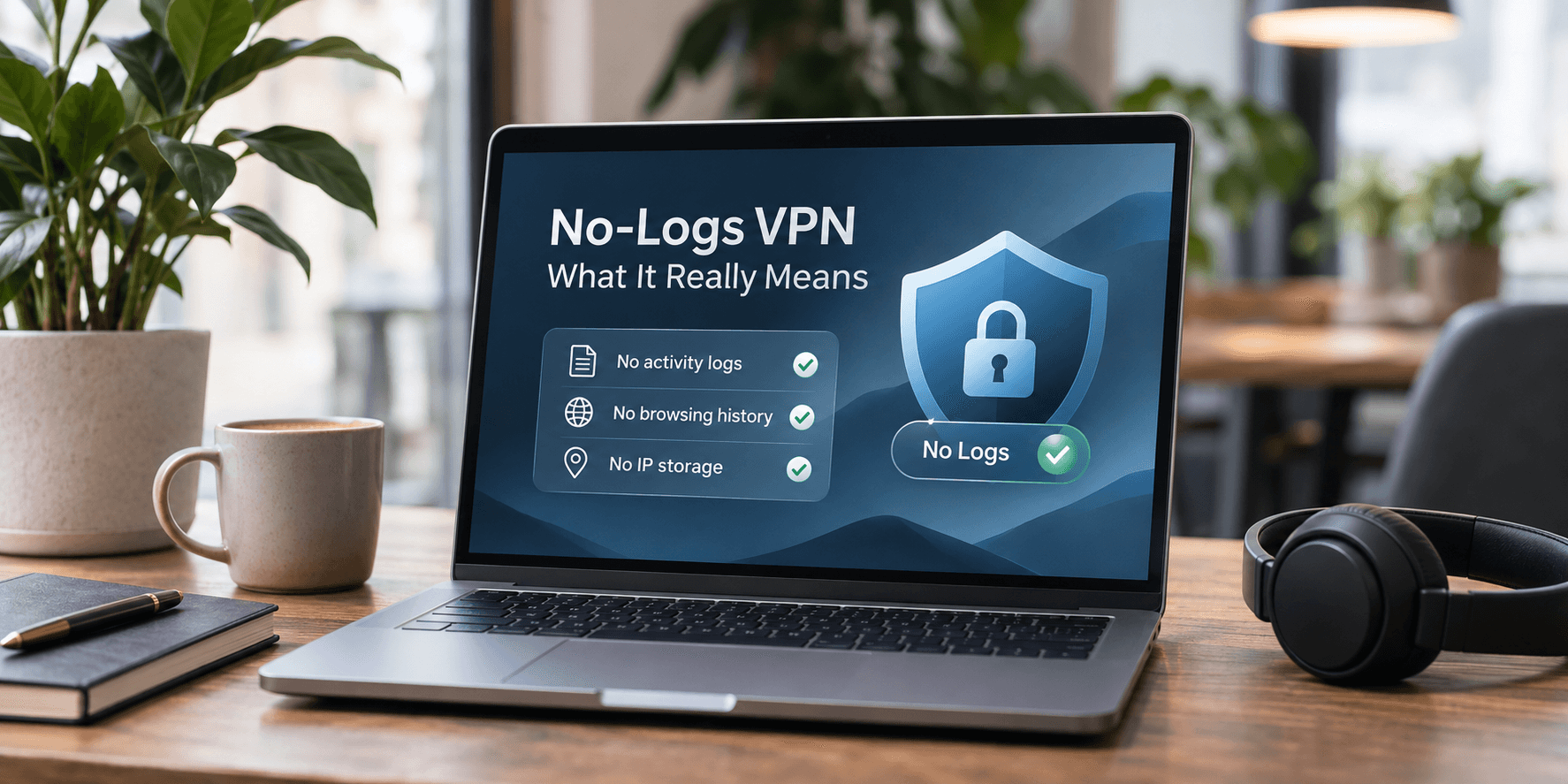
A no-logs policy is the most important promise a VPN makes, because a VPN can see where your traffic goes in the same way your internet provider can. If the VPN stores that information, you have simply moved the risk from one company to another. Here is what the claim really covers and how to tell who can prove it.
What "no logs" should mean
A credible no-logs VPN does not record:
- Activity logs: the websites you visit, the apps you use, your DNS queries or the content of your traffic.
- Connection logs that identify you: your real IP address, the VPN IP you were assigned, and timestamps that could link the two.
Many providers still keep some limited data, and that is not automatically a problem. Common examples are your account email and payment record, the number of devices currently connected (to enforce the device limit) and aggregated, anonymous server load statistics. What matters is that none of it can tie a specific online action back to you.
Why the claim alone is not enough
Anyone can write "we don't log" in a privacy policy. History shows why that is not enough:
- In 2016, court documents showed that IPVanish, under its owner at the time, provided information that helped US authorities identify a user despite advertising no logs.
- In 2017, PureVPN supplied connection data that helped the FBI identify a suspect, also despite a no-logs claim.
- In 2020, researchers found that several free VPN apps that claimed not to log had left a database of user logs exposed online.
Both IPVanish and PureVPN have since changed ownership or policies and introduced audits, but these cases are why proof matters.
The evidence that counts
Independent audits
The strongest routine evidence is an audit by a named firm such as Deloitte, PwC, KPMG, Cure53 or Securitum. Auditors examine server configuration, internal systems and staff procedures to check that logs are not being created. NordVPN, Surfshark, ExpressVPN, Proton VPN, Private Internet Access, CyberGhost and Mullvad have all published audits or audit summaries.
Read audits with care: most are a snapshot of one point in time and cover a defined scope. Recent, repeated audits are worth more than a single report from several years ago. PureVPN's continuous assurance program is one attempt to address that limitation.
Real-world tests
The most convincing evidence is a situation where the provider was forced to hand over data and could not:
- ExpressVPN (2017): Turkish authorities seized a server during an investigation and found no logs that identified users.
- Private Internet Access: in US court cases, PIA was asked for user data and had nothing usable to provide.
- Mullvad (2023): Swedish police arrived with a search warrant to seize computers with customer data and left without anything, because none existed.
RAM-only servers
When servers run entirely in memory, as with ExpressVPN's TrustedServer, NordVPN, Surfshark and Mullvad, data is wiped on every reboot and nothing persists on a hard drive. That does not prove a provider never logs, but it removes the most common way logs pile up.
Does jurisdiction matter?
A provider based in a country without mandatory data-retention laws is in a better starting position, and some users prefer to avoid the Five Eyes intelligence-sharing countries. But jurisdiction is secondary to architecture and proof: if no data is stored, there is nothing for any government to request. Private Internet Access is US-based yet has a court-tested no-logs record.
A quick checklist
- Is there a recent, published audit by a named firm?
- Has the claim been tested by a court order or server seizure?
- Do the servers run in RAM only?
- Does the provider publish a transparency report or warrant canary?
- Can you sign up with minimal personal data, as with Mullvad's and IVPN's account numbers?
Bottom line
"No logs" is only meaningful when it is backed by evidence. Favor providers with recent audits, RAM-only infrastructure and a record of having nothing to hand over. Our no-logs VPN roundup lists the providers that meet that bar.